Tuesday, November 28, 2006

How IBM leverages Open Source

Dana Blankenhorn recently blogged about IBMs reaction to Sun’s Java plan and their approach to open source ecosystem. I think Dana summarizes it very well. IBM believes Open Source is a great technology floor on which others and even IBM builds. But as Dana points out, it is naive to treat IBM a Solutions and Services company with rest of the software industry players who are primarily software vendors like Oracle, SAP, RedHat and Microsoft.

IBM is a very interesting player in the Open Source ecosystem and in my opinion- The Best. They understand how it works and also how to leverage it to their business goals. To their customers they are the trusted business partner and certainly portray themselves as open and flexible. They are very smart about where to contribute to get influence in open source and what/how to consume that meets their business objective. And the wonderful thing is that they had been able to pull this off by not ruffling many feathers in the community.


In the changed software landscape of open source the core competency is not “ S/W features” but “Speed” - Speed by which a firm can leverage external innovations not by copying everything but by quickly assembling products from proprietary and open components.


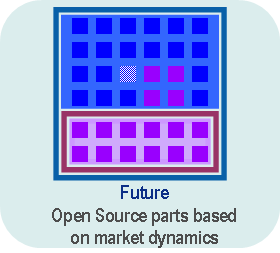
In my opinion IBM believes that in the long run all software is going to be free and open and hence does not have much value in itself. But the trick is to extract as much value as possible during the journey to the end state. And to do that they leverage "Pluggable Integration Architecture" a “Lego blocks” type approach that can accommodate both proprietary and open source components. Pluggable Integration Architecture are the new influence points and hence allow “opening” their existing S/W product portfolio in increments and on their terms.


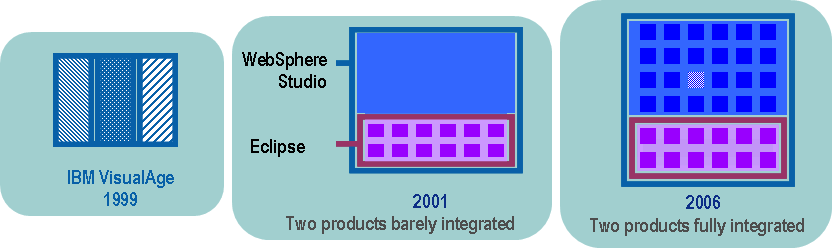
Eclipse showed how powerful pluggable architecture can be and certainly owning (in other words heavily influencing) the integration platforms that allow mixing of open and closed components is core to their strategy. In 1990 IBM tools were dismal but over time by using Eclipse as a way to build common integration framework IBM was able to transform its tools business. In the beginning Eclipse was a blob below proprietary WebSphere but over time the integration framework has been meshed into proprietary code positioning them well for future.

This totally changes the competitive landscape, now if market environment changes either from competitive pressure or by availability of better open source components; IBM now has a mechanism to respond fast. IBM can very easily slot in components from open source (like Apache httpd) and also commoditize components when it sees competitive threats (like modeling tools). By getting industry to adopt open integration framework they have a ready channel to slot in proprietary pieces on top of open pieces and IBM is in position to extract value on the road towards "Total Commoditization".


Now after having standardized the integration framework for tooling and IDE, IBM is now trying to do the same for runtimes. Geronimo is a great effort in that direction. It will be interesting to see how that plays out. Already there are signs that it doing very well (Report: IBM Open Source-Based Application Server Growing Nearly Three Times Faster Than JBoss).


And regarding Java, I believe very soon IBM will get over the gloom and then it will embrace it to make it yet another Lego block in the puzzle.


Tuesday, November 14, 2006

Discovering TimeBridge

I am sure you have had the Aha! Moments in your life and I had one of those last week when I saw TimeBridge at the Web 2.0 Summit. Scheduling with external customers had been a big pain for long time that both Stephen O'Grady and I have blogged before. This was an opportunity waiting to be snapped and I think TimeBridge is getting there.

TimeBridge has built a Personal Scheduling Manager that works across companies, time zones and calendaring systems. It is a “full service” service, in the sense that it provides help throughout the life cycle of setting up the meeting, lunch or other activity, including collaboration, distributing meeting materials and handling changes. It works for 1:1s as well as larger group meetings.

I played with their beta, it currently only works with Outlook but integrates very well with Outlook client. I could set meeting and anybody (even non-outlook) external users were able to use it through the website. What was missing was the ability to schedule meeting from the web applications itself. I am sure it is in the works.


Tuesday, November 07, 2006

Announcing SuiteTwo.com - An enterprise 2.0 solution powered by Intel

Today Intel is announcing the launch of SuiteTwo.com – a collection of web2.0 stack which is jointly developed by leading web2.0 players that include – MOVABLETYPE, SimpleFeed, Socialtext, Newsgator Spikesource.. We are announcing this at the currently ongoing Tim O’Reilly web2.0 conference at San Francisco, CA. SuiteTwo is a rich set of interconnected services that combine to improve productivity and enable high-engagement marketing. SuiteTwo includes the most trusted platforms for blogs, wikis, RSS feed reading, and RSS feed management, all under a single management interface.


This is a great first step for Intel in solving the ever increasing desire of enterprises to quickly deploy web2.0 technologies quickly inside the firewall. SuiteTwo. This had been a great effort at cross industry collaboration to bring solution to a sector quickly. Stay tuned we are already busy with version 2.0…


Sunday, November 05, 2006

PCs and web2.0 : Part 2 PCs the perfect Interaction Engines


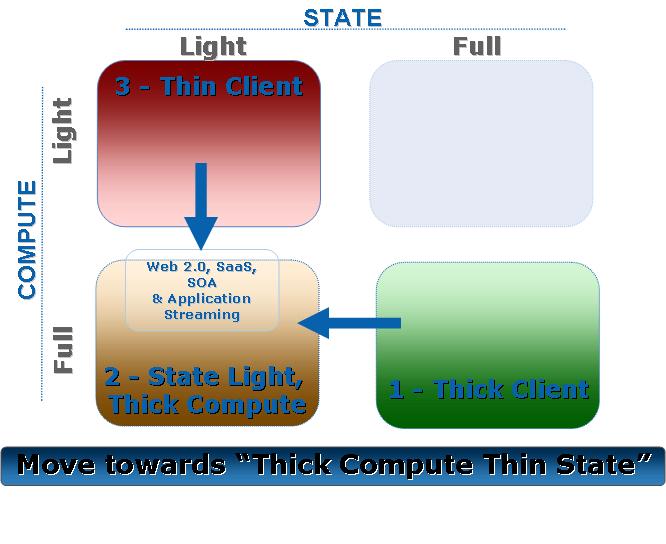
Last week I talked about how the PCs existing role is being threatened by the evolving push towards services based applications. There is a widespread fear that web2.0 and SaaS will finally kill the thick Moore's law driven PC and we all will be either working of dumb terminals or the cell phone size devices that will run all our applications. Certainly skeptics and realists are arriving and last weeks blog by John Milan talked about how Google's desktop based application strategy is evolving. I believe that PC type high end compute devices will still be around but certainly with a new defined role of providing stateless and cheap raw computes.

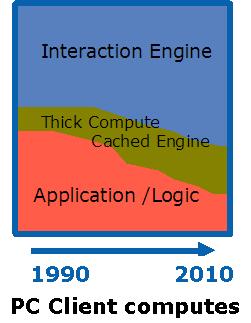
Going forward PC will take on more the role of local storage/caching/execution device. It is already happening, PC in home is already the synching & charging station, music mixer & browsing device, Sam Ruby from IBM has a great presentation on the topic. While in enterprise PCs are quickly becoming thin state compute player with role based applications/kiosks becoming commonplace.


Thick Compute Thin State: The end user client nodes though loosing lot of application level computes to the cloud are certainly gaining lot of interaction level computes. Be it the browser based application that uses lot of rich AJAX code such as Zimbra or the role based deployments of enterprise applications. I remember somebody mentioning me that the Zimbra demos looked awful till Intel Core2Duo showed up, especially thru in the case of Apple Macs. Certainly with loosely coupled applications and mashups happening at the last mile the interaction level computes are bound to rise at the point of interactions. Added to that increasing desire of flexibility and agility prompts development at higher level abstracted languages, pushing performance as a back burner and certainly consuming MIPS very inefficiently.

The tipping of broadband adoption beyond 50%, the availability of cheap hardware and open source stacks have finally brought in the ability to break out from the limitations of client server model. Applications are not going to be written in the old ways and that means applications can finally be experienced differently. Application streaming vendors and role based deployment stacks are bridging the gap for existing client server applications in the enterprise space while in the consumer space everybody seems to be rallying behind web2.0


PC going from Multi Applications to Multi Player It was while working on the PDS project at IBM T.J Watson lab that we coined the term “Application Player” for the first time. Applications that can be experienced as a stream similar to watching a MPEG file or internet radio stream. The real implication was that now one could treat compiled applications and play it like any media using a S/W player. This meant that the composition and packaging of application is totally independent of the way applications are run. After all we always knew that runtime characteristics of an application is totally different from the design time and compose time characteristics, just didn't know how to manage it differently. By being able to separate these attributes it is now possible to pull in some of the composition and assembly aspect of application into the cloud, while also make the edge a better runtime stateless player. I think Microsoft is also thinking in the same line and the increased focus on declarative languages like XUL, XAML, FLEX makes it easier to reach there.

This is the biggest opportunity for PC. PCs can now become the perfect form of interaction engine. Finally the glue that stuck OS and applications to PCs are loosening and PCs could be redefined into a platform for interaction. Things like device driver models that have become a nightmare inside the Operating system could be pulled back to the hardware and used to putting up a softer face. It is time for us to look beyond the keyboard and mouse interfaces and provide an interaction based programming interface and tools that can be applied to things such as multi-touch, voice, conversational systems, 360° camera. PC's or PC type devices will start becoming the enabler of the local infoclound. And with the onset of virtualization technology in chips and open source VMMs now we have the basic building blocks to build this.

I am excited by the opportunity and believe this is just the beginning. The whole service orientation of applications and ability to experience the Application Anywhere Anytime is finally going to bring the information to fingertips and is heralding in new era for computer science.

PC is marching towards becoming the perfect “Interaction Engine” and who knows how many unintended uses will emerge. Here is one that is using exisiting PC hardware to predict Tsunami's using vibrations on your hard disk

Thursday, October 19, 2006

PCs and web2.0 : Part 1 What made PCs so successful

There is enough written about the success of the PCs, and the overall impact it has had over decades. PCs not only are attributed to increased productivity, economic gains and creation of the Information Technology business. I don’t have to delve into it very much. What I am trying to do is look at PCs and their role in the changing landscape of services based application, call it web2.0, SOA or some flavor of SaaS. I am using the term PCs very loosely here to refer to PC type devices that are the clients/desktops/notebooks that end user use.

PCs became successful because they were the ultimate “Multiple-Application” player. Before PCs compute capability was something that people with halos around their head worked on in the safety of cold closed enclosures. PCs changed all that, suddenly everybody had a platform on top of which they could write real world applications that solved real needs. It resulted in overall increased productivity but also gave us multiple booms including the massive Y2K spending.


But since the real PC innovation of early 80s things have not changed much. In fact if you look at various citing on history of PC almost all of them stop around 1985s. We had the Linux revolution but the fundamental physical form factor and H/W Spec never changed.

PC brought compute to the common man and hence replicated (in small form) the compute characteristics of standalone mainframes. Certainly it provided a steady platform for innovation to happen at the application level tied to the operating systems. Client-server world of applications design was always tuned towards replicating portions of computation and then doing some form of update between clients and server to get applications to work together. But for all practical reason they were individual units of compute. These PCs were not inherently designed to be working in connected world, Windows for Workgroup (3.11) was an almost an afterthought.

The PCs of the 90s performed three important tasks. Its foremost role used to be that of executing application. The process by which computer grinds through the bits of logical commands, interprets and produces intelligent stuff. Things that made Word run and PhotoShop do its magic.

By its very nature client PC needed to support the role of an “interaction interface” it second major role. The I/O interface that made computer understands humans and vice versa.

The third important role it provides is that of an information repository (mainly file store today). Repository that stores your life at home and vital files/data that makes businesses work

So the PC performed three basic functions – Application Execute, Interaction and Storage.

Even the advent of networking did not change this much. Before networking client-server compute meant you carried around physical copies of data and now in the networked world you could start each client node as an extension of the file-system from the server and vice versa. (Even that was not seamless though…topic for some other day)

The advent of web browser and pervasiveness of internet (now called web 1.0) did not change that much either. All it did was allowed distributed client nodes to uniquely point and click stuff that was on the other end. Now you could uniquely access files that were published anywhere in the world wide web and bring them to your machine for viewing or manipulating. The user experience was still very limited and was constrained by the requirements that the files had to now work in uniform way across multiple platforms and operating systems. So browser took the easy route – target the least common denominator. AJAX changes that a bit and is finally trying to bring client server compute to the browser.

One of the biggest thing Internet’s and popularity of HTML/Script showed was the real potential of separating User Interface (HTML) from code (JavaScript). Certainly the critics would say HTML was not the first but the point is HTML brought it to masses (technology that is not for masses is useless. I have seen enough of that in my days at IBM Watson labs). Style sheets and DOM finally drove the point home that separating U/I from the inherent logic have huge potential – not only to address transformation but also to scale and support personalization. This is the ground work that started us towards loosely binded U/Is, finally mashups are ready to take over where the promises of Composite Application left

What web2.0 drove home very clearly but the other industry trends like XUL, Laszlo, JSF, ASP+ were already doing was this notion of separating U/I from code. Coding U/I in a declarative form that could be processed independent of the application logic has become the cornerstone for U/I rendering including FLEX & XAML. And with the pervasive connectivity and increasing adoption of broadband, consumer now has a thicker/faster pipe coming the last mile. We now have the perfect ingredient to finally start separating the Application, Storage & Interaction.

Suddenly you are in a situation where Application Execute could be separated from Interaction and Storage could be distributed. Now PCs don’t have to do the role of data repository & application execution engine. Browsers have taken upon themselves to fulfill the role of platform and OS agnostic interaction engine. And there are anecdotal evidences that we are slowly moving toward that. For example BW says that in the last year the two niches in which PC Software have done very well (except OS) include “Security” (things you buy to make sure you have a working PC next time you want to do something useful) and PC Games. (One exception is the Turbo Tax which shows people still worry about where there sensitive data resides. But it could be a very US/Western phenomenon)

With pervasive connectivity and programming models that are easy to separate application, data storage and interaction it makes lot sense to pull some of the computation back into the cloud , You have better view of application and hence can do faster adaptive applications”.

Accessing “Appications AnyWhere Anytime” will continue. This mandates that applications need to scale/adjust to all forms of device forms and interactions. It also means that applications cannot assume its interaction type and this example of Google Earth where users have come up with a totally new way to interact with Google Earth is a great showcase of this capability. Certainly we will have more richer interactions happening as more and more content is created and the edge nodes starts getting sucked into the cloud.

Also separating data that can sit in the cloud allows all forms of ways in which data can be used (Maybe that is what Tim means when he says “Data is the next Intel Inside”). Interaction is the glue that connects user to the machine and will always be in the edge and there sits the biggest opportunity for an edge compute device or the “new PC

All is not lost for the old PC more on that next week……

Sony Mylo ready to rock

http://gigaom.com/2006/10/13/mylo-t-mobile/

.. Sony announced a deal with T-Mobile that gives Mylo-users a year of free access to T-Mobile’s WiFi hotspots ...


This fixes a major hole in the Mylo strategy but now I think Mylo is ready to rock. Already it has got deal going with application vendors including GoogleTalk now.

Monday, June 26, 2006

Intel: Meet Darwin

Pretty well put by Geoff Moore. A great guidance and lesson for anybody trying to be a platform player.

Dealing with Darwin demands counter-intuitive actions, specifically when the environment has changed in some fundamental way that invalidates one’s traditional source of competitive advantage. … The competitive advantage position is changed. It remains to be seen if Intel can adapt and define competitive advantages in adjacencies.

This past week Intel surprised analysts with the latest in a set of uncharacteristically weak performances, especially in comparison with AMD. This has led some analysts to question Paul Otellini’s suitability to lead the company, falling prey to an over-fixation on CEO behavior that serves up glib answers on demand. What is really going on is far more systemic and far-reaching.

Intel has lost proprietary architectural control over the x86 architecture. AMD demonstrated this conclusively by being the first to design and ship a 64-bit version of x86 called Opteron. Intel rapidly followed with a 64-bit Xeon, but the genie was out of the bottle. The market was able to follow AMD without waiting for Intel’s endorsement, effectively communicating the x86 had become an open standard.

How did this happen? The script is eerily familiar and was set in motion long before Mr. Otellini took the stage. It is a story of flight from cannibalization¸ a known form of business tragedy, with striking parallels to IBM’s abortive attempt to substitute a proprietary PS2 MicroChannel Architecture in place of the widely adopted EISA architecture that enabled PC-licensed clones to compete with it directly on price. In that case an incumbent gorilla sought to create distance between a low-end commoditizing standard and a high-end next-generation capability. Instead the market voted for a third alternative, an upgraded version of the commodity, in the form of the Compaq 386 PC..

So it has been with Intel and its attempt to divide the market between the “scale out” architecture of the x86 and the “scale up” architecture of the Itanium microprocessor family. To be sure, there is a real and valuable RISC replacement market that Itanium can and will address, one where it competes with IBM’s Power PC and Sun’s SPARC. But by attempting to minimize x86 cannibalization between the two market dimensions, Intel actually left the door open to AMD to create a third alternative, a 64-bit multi-core x86-compatible microprocessor, something the market has embraced with a vengeance.

That market response, in turn, installs AMD as the leader in this phase of x86 development, just as Compaq’s 386 stole the leadership mantle from IBM. Whether or not AMD can keep it is an open question. The significant fact is, it is now in play!

OK, now what? The key to navigating market dynamics going forward is to recognize that while markets based on proprietary standards can stabilize at splits as high as 90/10 (Microsoft Windows, Microsoft Office, Cisco routers, IBM mainframes), those based on shared standards rarely tolerate more than a 20% gap between the lead vendor and its closest competitor (application servers, SQL databases, PCs, plasma TVs). Open choice with modest to low switching costs is the leveling influence. Under these dynamics, one would expect the Intel/AMD split of x86 products to stabilize at 60/40 or so, meaning AMD can gain another 20 points of share simply by showing up!

Now, of course, Intel can and will fight this shift, but if the genie truly is out of the bottle (I think it is, but the point is clearly debatable), then it is no longer a matter of if, only a matter of when the market “normalizes” (a condition which will certainly not look normal to Intel). That is why the company was correct when earlier this week it refused to launch an expected scorch-the-earth price war with AMD. It makes no sense to claw back market share in price-only competitions if there is no way to retain that share profitably. It does make sense, of course, to leverage the company’s immense manufacturing resources to fight profitable battles against AMD, slowing erosion and pocketing literally billions of dollars before the new equilibrium is achieved. But in a world of 60/40 splits, that is still a strategy of “not if, but when.”.

There is one other strategic alternative open to the company, one which admittedly at first glance looks like calling in an air strike on one’s own position: Intel could license the x86 architecture to one or two additional manufacturers! Why in the world would it ever do that? Well, 60 percent market share is a more powerful position in a 60/25/10/5 split than in a 60/40 split. The bet would be that the overwhelming preponderance of revenues going to vendors 3 and 4 would come at AMD’s expense, not its own.

Is this a good idea? Who knows? If it worked, it would be brilliant; if it failed, it would be idiotic. All one can say right now is that it would be an awfully gutsy bet. Would it be more gutsy than, say, Sun putting Solaris out as Open Source? Yes, because Sun was in direr straits at the time, not only losing the war against Linux but the battle against IBM and HP Unix as well.

My main point here, however, is that there are times when dealing with Darwin demands counter-intuitive actions, specifically when the environment has changed in some fundamental way that invalidates one’s traditional source of competitive advantage. Intel’s abandonment of its Intel Inside positioning in favor of migrating from a product to a platform innovation strategy (see earlier blog) is one manifestation of such action. It is a move that clearly anticipated the erosion of power we are now witnessing. But I have to believe Intel management assumed a softer landing than it is now experiencing. In any event, they have set a self-imposed deadline of 90 days to respond. When comes calling, it important not to keep him waiting in the lobby.

Saturday, June 24, 2006

Time to quit?

Great piece by Seth Godin justifies why I left IBM

http://sethgodin.typepad.com/seths_blog/2006/06/time_to_quit.html


The Cowen Group reminds me of this piece I wrote about five years ago:

I just got back from lunch with my friend Doug Jacobs.

Doug just got another promotion. He works for a software company in Indiana, and over the last 14 years, he's had a wide range of jobs. For the first seven or eight years, Doug was in business development and sales. He handled the Microsoft account for a while, flying to Redmond, Washington, every six weeks or so. It was hard on his family, but he's really focused -- and really good.

Two years ago, Doug got a huge promotion. He was put in charge of his entire division -- 150 people, the second-biggest group in the company. Doug attacked the job with relish. In addition to spending even more time on the road, he did a great job of handling internal management issues.

A month ago, for a variety of good reasons, Doug got a sideways promotion. Same level, but a new team of analysts report to him. Now he's in charge of strategic alliances. He's well-respected, he's done just about every job and he makes a lot of money.

So, of course, I told him to quit.

“You've been there a long time, my friend.”

Doug wasn't buying it: “Yes, I've been here 14 years, but I've had seven jobs. When I got here, we were a startup, but now we're a division of Cisco. I've got new challenges, and the commute is great --”

I interrupted him before he could go on. I couldn't help myself.

Doug needs to leave for a very simple reason. He's been branded. Everyone at the company has an expectation of who Doug is and what he can do. Working your way up from the mailroom sounds sexy, but in fact, it's entirely unlikely. Doug has hit a plateau. He's not going to be challenged, pushed or promoted to president. Doug, regardless of what he could actually accomplish, has stopped evolving -- at least in the eyes of the people who matter.

If he leaves and joins another company, he gets to reinvent himself. No one in the new company will remember young Doug from 10 years ago. No, they'll treat Doug as the new Doug, the Doug with endless upside and little past.

Let's look at it from the perspective of evolution: Species that evolve the fastest are the ones that don't mate for life. By switching mates, swapping genes with someone new, you continually reshuffle the gene pool, making it more likely you'll create something new and neat and novel and useful.

Our parents and grandparents believed you should stay at a job for five years, 10 years or even your whole life. But in a world where companies come and go -- where they grow from nothing to the Fortune 500 and then disappear, all in a few years -- that's just not possible.

Here's the deal, and here's what I told Doug: The time to look for a new job is when you don't need one. The time to switch jobs is before it feels comfortable. Go. Switch. Challenge yourself; get yourself a raise and a promotion. You owe it to your career and your skills.

No word back from Doug yet. How about you?

[this is post #1505 for my blog (I missed the milestone earlier in the week.) No plans to quit any time soon, I'm afraid].


Monday, March 27, 2006

Seven rules for corporate blogging

Great rules on best practises for corporate blogging by Nicolas Carr..

You (corporation) are getting into corporate blogging because you want to –

-Put human face to your corporate messaging
-Virally promote your side of the story
-Gain trust and credibility with the end user
-Be prepared for both positive and negative stuff – but are willing to do what is good for the customer

I certainly like his idea of having buddy and having a policy (lawyer stuff). Certainly the humans you put might err and say something stupid and it is possible that he/she might loose audience. But it is OK as long as corporation keeps away from the content he/she is putting out all they are doing is removing barrier to express opinions. And of course gain from the new insights about themselves they might get.

Thursday, August 18, 2005

Why is Scheduling Still So Damn Hard?

Stephen recently wrote

What I would love is to be able to offer - selectively or publicly - visibility into my calendar, with ACL based write access that's easy enough for anyone to use. The sheer amount of time this would save come conference time, when 10's or 100's of people are asking for time with us, would be worth its weight in gold. It would allow us to push the burden of scheduling onto those who request our time. You want to meet with us? Great. Here's the schedule, knock yourself out.


I totally agree this is the BLOG tool for the collaborative scheduling. What needs to be built is a standard way to export the calendar entries , I think iCal has a good shot at it and then some tools can be built to intermediate the negotiation. Another use case is where you don't really want to show all your calendar busy times but only show a view/subset of it. Anybody interested in collaborating on this one?

Friday, August 05, 2005

You've got to find what you love - Steve Job

Stanford Report, June 14, 2005 'You've got to find what you love,' Jobs says
http://news-service.stanford.edu/news/2005/june15/jobs-061505.html

Very inspiring piece

- Jobi

------------------------------------------


This is the text of the Commencement address by Steve Jobs, CEO of Apple Computer and of Pixar Animation Studios, delivered on June 12, 2005.

I am honored to be with you today at your commencement from one of the finest universities in the world. I never graduated from college. Truth be told, this is the closest I've ever gotten to a college graduation. Today I want to tell you three stories from my life. That's it. No big deal. Just three stories.
The first story is about connecting the dots.

I dropped out of Reed College after the first 6 months, but then stayed around as a drop-in for another 18 months or so before I really quit. So why did I drop out?
It started before I was born. My biological mother was a young, unwed college graduate student, and she decided to put me up for adoption. She felt very strongly that I should be adopted by college graduates, so everything was all set for me to be adopted at birth by a lawyer and his wife. Except that when I popped out they decided at the last minute that they really wanted a girl. So my parents, who were on a waiting list, got a call in the middle of the night asking: "We have an unexpected baby boy; do you want him?" They said: "Of course." My biological mother later found out that my mother had never graduated from college and that my father had never graduated from high school. She refused to sign the final adoption papers. She only relented a few months later when my parents promised that I would someday go to college.

And 17 years later I did go to college. But I naively chose a college that was almost as expensive as Stanford, and all of my working-class parents' savings were being spent on my college tuition. After six months, I couldn't see the value in it. I had no idea what I wanted to do with my life and no idea how college was going to help me figure it out. And here I was spending all of the money my parents had saved their entire life. So I decided to drop out and trust that it would all work out OK. It was pretty scary at the time, but looking back it was one of the best decisions I ever made. The minute I dropped out I could stop taking the required classes that didn't interest me, and begin dropping in on the ones that looked interesting.
It wasn't all romantic. I didn't have a dorm room, so I slept on the floor in friends' rooms, I returned coke bottles for the 5¢ deposits to buy food with, and I would walk the 7 miles across town every Sunday night to get one good meal a week at the Hare Krishna temple. I loved it. And much of what I stumbled into by following my curiosity and intuition turned out to be priceless later on. Let me give you one example:

Reed College at that time offered perhaps the best calligraphy instruction in the country. Throughout the campus every poster, every label on every drawer, was beautifully hand calligraphed. Because I had dropped out and didn't have to take the normal classes, I decided to take a calligraphy class to learn how to do this. I learned about serif and san serif typefaces, about varying the amount of space between different letter combinations, about what makes great typography great. It was beautiful, historical, artistically subtle in a way that science can't capture, and I found it fascinating.

None of this had even a hope of any practical application in my life. But ten years later, when we were designing the first Macintosh computer, it all came back to me. And we designed it all into the Mac. It was the first computer with beautiful typography. If I had never dropped in on that single course in college, the Mac would have never had multiple typefaces or proportionally spaced fonts. And since Windows just copied the Mac, its likely that no personal computer would have them. If I had never dropped out, I would have never dropped in on this calligraphy class, and personal computers might not have the wonderful typography that they do. Of course it was impossible to connect the dots looking forward when I was in college. But it was very, very clear looking backwards ten years later.

Again, you can't connect the dots looking forward; you can only connect them looking backwards. So you have to trust that the dots will somehow connect in your future. You have to trust in something - your gut, destiny, life, karma, whatever. This approach has never let me down, and it has made all the difference in my life.
My second story is about love and loss.

I was lucky – I found what I loved to do early in life. Woz and I started Apple in my parents garage when I was 20. We worked hard, and in 10 years Apple had grown from just the two of us in a garage into a $2 billion company with over 4000 employees. We had just released our finest creation - the Macintosh - a year earlier, and I had just turned 30. And then I got fired. How can you get fired from a company you started? Well, as Apple grew we hired someone who I thought was very talented to run the company with me, and for the first year or so things went well. But then our visions of the future began to diverge and eventually we had a falling out. When we did, our Board of Directors sided with him. So at 30 I was out. And very publicly out. What had been the focus of my entire adult life was gone, and it was devastating.

I really didn't know what to do for a few months. I felt that I had let the previous generation of entrepreneurs down - that I had dropped the baton as it was being passed to me. I met with David Packard and Bob Noyce and tried to apologize for screwing up so badly. I was a very public failure, and I even thought about running away from the valley. But something slowly began to dawn on me – I still loved what I did. The turn of events at Apple had not changed that one bit. I had been rejected, but I was still in love. And so I decided to start over.

I didn't see it then, but it turned out that getting fired from Apple was the best thing that could have ever happened to me. The heaviness of being successful was replaced by the lightness of being a beginner again, less sure about everything. It freed me to enter one of the most creative periods of my life.

During the next five years, I started a company named NeXT, another company named Pixar, and fell in love with an amazing woman who would become my wife. Pixar went on to create the worlds first computer animated feature film, Toy Story, and is now the most successful animation studio in the world. In a remarkable turn of events, Apple bought NeXT, I retuned to Apple, and the technology we developed at NeXT is at the heart of Apple's current renaissance. And Laurene and I have a wonderful family together.

I'm pretty sure none of this would have happened if I hadn't been fired from Apple. It was awful tasting medicine, but I guess the patient needed it. Sometimes life hits you in the head with a brick. Don't lose faith. I'm convinced that the only thing that kept me going was that I loved what I did. You've got to find what you love. And that is as true for your work as it is for your lovers. Your work is going to fill a large part of your life, and the only way to be truly satisfied is to do what you believe is great work. And the only way to do great work is to love what you do. If you haven't found it yet, keep looking. Don't settle. As with all matters of the heart, you'll know when you find it. And, like any great relationship, it just gets better and better as the years roll on. So keep looking until you find it. Don't settle.

My third story is about death.

When I was 17, I read a quote that went something like: "If you live each day as if it was your last, someday you'll most certainly be right." It made an impression on me, and since then, for the past 33 years, I have looked in the mirror every morning and asked myself: "If today were the last day of my life, would I want to do what I am about to do today?" And whenever the answer has been "No" for too many days in a row, I know I need to change something.

Remembering that I'll be dead soon is the most important tool I've ever encountered to help me make the big choices in life. Because almost everything – all external expectations, all pride, all fear of embarrassment or failure - these things just fall away in the face of death, leaving only what is truly important. Remembering that you are going to die is the best way I know to avoid the trap of thinking you have something to lose. You are already naked. There is no reason not to follow your heart.

About a year ago I was diagnosed with cancer. I had a scan at 7:30 in the morning, and it clearly showed a tumor on my pancreas. I didn't even know what a pancreas was. The doctors told me this was almost certainly a type of cancer that is incurable, and that I should expect to live no longer than three to six months. My doctor advised me to go home and get my affairs in order, which is doctor's code for prepare to die. It means to try to tell your kids everything you thought you'd have the next 10 years to tell them in just a few months. It means to make sure everything is buttoned up so that it will be as easy as possible for your family. It means to say your goodbyes.
I lived with that diagnosis all day. Later that evening I had a biopsy, where they stuck an endoscope down my throat, through my stomach and into my intestines, put a needle into my pancreas and got a few cells from the tumor. I was sedated, but my wife, who was there, told me that when they viewed the cells under a microscope the doctors started crying because it turned out to be a very rare form of pancreatic cancer that is curable with surgery. I had the surgery and I'm fine now.

This was the closest I've been to facing death, and I hope its the closest I get for a few more decades. Having lived through it, I can now say this to you with a bit more certainty than when death was a useful but purely intellectual concept:
No one wants to die. Even people who want to go to heaven don't want to die to get there. And yet death is the destination we all share. No one has ever escaped it. And that is as it should be, because Death is very likely the single best invention of Life. It is Life's change agent. It clears out the old to make way for the new. Right now the new is you, but someday not too long from now, you will gradually become the old and be cleared away. Sorry to be so dramatic, but it is quite true.
Your time is limited, so don't waste it living someone else's life. Don't be trapped by dogma - which is living with the results of other people's thinking. Don't let the noise of other's opinions drown out your own inner voice. And most important, have the courage to follow your heart and intuition. They somehow already know what you truly want to become. Everything else is secondary.

When I was young, there was an amazing publication called The Whole Earth Catalog, which was one of the bibles of my generation. It was created by a fellow named Stewart Brand not far from here in Menlo Park, and he brought it to life with his poetic touch. This was in the late 1960's, before personal computers and desktop publishing, so it was all made with typewriters, scissors, and polaroid cameras. It was sort of like Google in paperback form, 35 years before Google came along: it was idealistic, and overflowing with neat tools and great notions.
Stewart and his team put out several issues of The Whole Earth Catalog, and then when it had run its course, they put out a final issue. It was the mid-1970s, and I was your age. On the back cover of their final issue was a photograph of an early morning country road, the kind you might find yourself hitchhiking on if you were so adventurous. Beneath it were the words: "Stay Hungry. Stay Foolish." It was their farewell message as they signed off. Stay Hungry. Stay Foolish. And I have always wished that for myself. And now, as you graduate to begin anew, I wish that for you.

Stay Hungry. Stay Foolish.
Thank you all very much.
Thursday, August 04, 2005

Plazes: Simple Solution to a really difficult problem


Simple Solution to a really difficult problem
Checkout : http://beta.plazes.com/home/

Plazes is a grassroot approach to location-aware interaction, using the local network you are connected to as location reference. Plazes allows you to share you location with the people you know and to discover people and plazes around you.


Plaze = Location + Context:
A Plaze is a physical location with a local network - private or public, wired or unwired. A Plaze constitutes of the information about the actual location like pictures, comments and mapping information, as well as the people currently online at that Plaze.

Really cool.. My Coordinates today :-)

Amazon files for Web services patent

I think this is a very key patent to their approach in creating a marketplace for WebServices. Also tied in with their A9 efforts one can now not only search for the third party WebServices but also bind dynamically and pay to consume and disconnect.

Amazon.com has received a public airing of its patent application for an online marketplace where consumers search and pay for Web services.
The patent application, filed last year and published Thursday by the U.S. Patent and Trademark Office, marks the online retailing giant's latest attempt to make inroads into consumers' wallets.

Amazon, in its latest filing, is seeking to patent its idea for creating a marketplace where third-party Web services providers can link up with consumers.
In the marketplace, consumers can search for Web services and read comments and reviews from others who have used the service. Amazon can also provide the suppliers of these services with assurances that only authorized consumers can access their offerings...

Wednesday, June 29, 2005

Ken Norton on Product Manager

Finally somebody wrote about the really obscure art of finding good Product Manager, It also allows one to look inward and see if they are PM material. Ken Norton is a veteran in recruiting PMs and it shows . Thanks for the great article

Thursday, June 23, 2005

How to Stop Worrying and Learn to Love the Internet

Douglas Adams, from the Hitchhikers fame wrote this in 1999. Still so relevant. I had a chance to listen to him in the closing keynote at JavaOne in 1999, such a great talk makes you sit back and think of perspectives not just on technology. I recommend reading the whole article. Here are some excerpts -


I suppose earlier generations had to sit through all this huffing and puffing with the invention of television, the phone, cinema, radio, the car, the bicycle, printing, the wheel and so on, but you would think we would learn the way these things work, which is this:

1) everything that'’s already in the world when you are born is just normal;

2) anything that gets invented between then and before you turn thirty is incredibly exciting and creative and with any luck you can make a career out of it;

3) anything that gets invented after youĂ‚’re thirty is against the natural order of things and the beginning of the end of civilisation as we know it until it's been around for about ten years when it gradually turns out to be alright really.


Apply this list to movies, rock music, word processors and mobile phones to work out how old you are.


...

Because the Internet is so new we still don'’t really understand what it is. We mistake it for a type of publishing or broadcasting, because that i’s what we are used to.

Another problem with the net is that it'’s still ‘technology, and ‘technology’, as the computer scientist Bran Ferren memorably defined it, is ‘stuff that doesn'’t work yet. We no longer think of chairs as technology, we just think of them as chairs. But there was a time when we hadn'’t worked out how many legs chairs should have, how tall they should be, and they would often "crash"’ when we tried to use them. Before long, computers will be as trivial and plentiful as chairs (and a couple of decades or so after that, as sheets of paper or grains of sand) and we will cease to be aware of the things.

Thursday, June 02, 2005

Rich Internet Application Framework from Backbase

Just ran across Backbase (http://www.backbase.com) a well designed thin script based U/I development framework. It uses an XML-based User Interface language and leverages XHTML, CSS and DOM. It requires no install /plugin/java/Flash and yet are very powerful. It also seem to work fine in IE and Firefox.

They use AJAX patterns heavily and leverage the browser XML namespace support.

Demos -
Shoping - New way to shop
Portal - A new way to do responsive Portlets based U/I
Google : Totally new way to experience search using Google API and using drag & drop to bookmark

Backbase has introduced BXML, a declarative GUI language. BXML consists of about 85 B-tags and over 200 attributes that can be freely mixed with HTML. They give the developer access to best practices in user interface design, while still augmenting existing web development skills. The Backbase Client transforms the B-tags into the proper HTML, CSS and JavaScript code, and it ensures compatibility with each browser. There are B-tags for many different purposes:

  • Defining the layout (panels, windows and decks)
  • Styling the interface (themes and skins)
  • Creating user interface controls (menus, tabs, trees, sliders, etc.)
  • Adding behaviors (display, hide, loading data, animations, etc.)
  • Including form functionality (conditional forms, input validation)

Extending the namespace support to clean up the page layout code seems to be in vogue. Another project Novell Xforms is a cute project leveraging that for xform implementation.
Years ago I was part of the team that did the Xform 1.0 implementation that we contributed to IBM Alphaworks site It formed the basis for some of the IBM products that are coming out with revised implementation. Given a second chance we would love to go back and redo it using namespaces and not IE Mime handler.

Wednesday, June 01, 2005

WebSphere Browser Framework and Faces Client

WebSphere Browser Framework (now called Faces Client) for WebSphere Studio provides a set of JSF based U/I Controls and Data Emitters for doing Rich browser applications without server round trips. It provided client-side processing coupled with a client-side data model to reduce server and network loads and user wait times. The result: richly interactive Web applications utilizing JavaScript for client-side processing and data structuring without browser or client upgrades.

A key Browser Framework component is its structured data model that supports dynamic data manipulation -- meaning that data could be lately bounded and can be manipulated on the client, either by the user or through a Web service or other Web-based update mechanisms, without a page-refresh. We had a Eclipse Modelling Framework EMF Core classes (http://www.eclipse.org/emf) based implementation. The BF framework also provides rich user interface controls that were tied to JSF based emitters -Twisty, TreeView, DataGrid, ListView, TabbedPanel, DatePicker, GraphDraw, and Dialog.

Some of the design aspects we talked about in our 2004 paper in IBM Systems Journal

Browser Framework used some of the design patterns that WebSites such as Flickr and Laslo are using today. I developed a javascript based generic interface for WebServices WSDL parsing and requester using Flash Player. Another cool component was the generic Chart component which used the Movie concept to Flash Player to paint Pie, Line and Bar Charts without server round trips

Here is an image of some of the controls and a portal app -

TIBCO General Interface (RIA)

Check out Jon Udell's screencast showing a demo of the TIBCO General
Interface, a JavaScript/DHTML framework for building Internet Apps.

Blog: http://weblog.infoworld.com/udell/2005/05/25.html#a1238
Screencast: http://weblog.infoworld.com/udell/gems/tibco.html (8 mins.)

The tool is built using a javascript based toolkit. Very cool and looks very detailed. Waiting to play with it once it is out.

My team did similar framework for WebSphere Application Developer 5.1.2. which was called the Browser Framework and JSF Javascript Emitters. I will cover that in another post.